![[APHA]](/images/logo_apha.svg)
About APHA
The Australian Private Hospitals Association (APHA) is the peak national body representing private hospitals across Australia, encompassing small, medium and large hospital groups; small, medium and large independent hospitals; specialist psychiatric hospitals and rehabilitation hospitals; and day surgeries.
Private Hospitals
Breakdown of economic contribution of, and jobs supported by, private hospitals across all states and territories.
Do you know private hospitals perform 70% of all planned surgeries in Australia – 1.75 million a year? Or that they provide 1.63 million medical treatments each year?
Where would Australia's public hospitals be without a viable private sector when they do the heavy lifting across so many areas?
While private hospital closures and service cancellations have marred recent years and plunged both private healthcare and public hospitals into crisis, the contribution of private hospitals to the health and wellbeing of Australians, and the health system as a whole, remains pivotal.
It is a credit to private hospital operators and their staff that the sector managed to care for the surgical, medical, psychiatric and rehabilitation needs of over 5.1 million admitted patients last year.
Australians reap a massive return on zero investment in private hospitals. While 704 public hospitals are funded by taxpayers to the tune of around $450 billion over five years, private hospitals receive no funding from taxpayers.
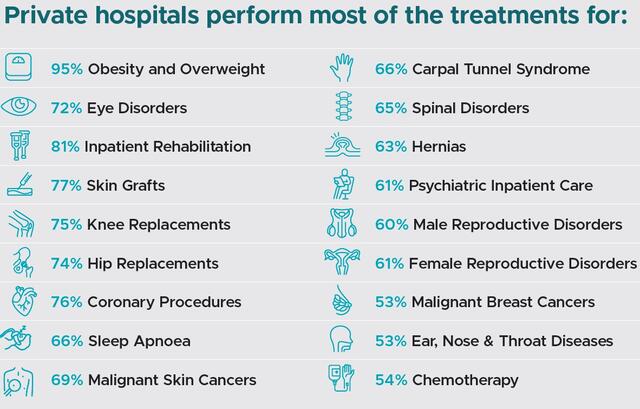
Yet, Australia's 637 private hospitals account for 70% of all planned surgeries, 60% of acute mental health care, 82% of rehabilitation hospitalisations and 1.63 million medical treatments each year, including 53% of all chemotherapy.
With 12.8 million Australians (or 46% of the population) holding private hospital insurance, the sector's fundamental importance to the lives of those directly relying on it traverses all walks of life across metropolitan, suburban, peri urban, regional and rural Australia. It also indirectly positively impacts the lives of all Australians, shouldering a healthcare burden that would otherwise see the public health system collapse.
Directly employing 159,000 Australians; including 60,000 nurses, as well as allied health professionals; private hospitals underpin over 229,000 jobs in all - equivalent to 186,291 full-time positions.
Private hospitals are vital community assets and a mainstay of the national economy driving over $27 billion-a-year in economic activity. They are vital to multiple layers of healthcare provision, allied industry jobs and broader economic activity through their upstream and downstream supply chain interactions every day.
For more facts and statistics on private hospital activity, see PH Facts
Our Role
Given the major contribution private hospitals make to Australian healthcare, the sector needs strong representation.
Encompassing the lion's share of private hospitals across the nation, the APHA is committed to the responsible promotion of the contribution and importance that private hospitals provide through policy and research development, political and public advocacy, engagement with multiple and varied stakeholders and forums, and the vital two-way communication with its members.
Established in 1981, APHA has earned a reputation as a forthright leader in the identification, development and achievement of positive policy and technical outcomes to champion issues affecting private hospitals and suppliers, the broader healthcare sector and the clinical needs of, and value for, patients.
We are dedicated to generating more informed understanding and appreciation of the evolving role private hospitals play today, and must play into the future, to deliver the choice, access, quality, reliability, affordability and timeliness expected by patients.
Indeed, these have been hallmarks of Australia's complementary public-private hospital system, differentiating it from the undesirable polar extremes of the UK's NHS and the US insurer-dominated systems.
The APHA is served by a National Board, elected every two years. Board members are elected from the APHA Council, who are elected representing member constituencies ranging from small, medium and large hospital groups; small, medium and large independent hospitals; specialist psychiatric and rehabilitation hospitals; and day surgeries.
Membership
Under the APHA Constitution, membership is available to suitable private hospitals, including for profit and not-for-profit operators, as well as associate membership, which is available to suppliers and other participants in the healthcare sector.
Members are bound by the Constitution and afforded rights and entitlements. They are directly engaged and involved in various aspects of the Association's activities and functions, including its Committees and Taskforces.
Associate Members are afforded collaborative benefits, but have do not enjoy the rights of members. They are actively engaged and involved in considerations pursued by the Association.
For more details on the current membership of the APHA, see Our Members.