![[APHA]](/images/logo_apha.svg)
NEW data from the Australian Prudential Regulation Authority (APRA) shows insurers are still coming up short of what's needed to keep private healthcare viable.
The latest quarterly figures show the benefit payout ratio at a mere 86.3% in December 2025, up from 84.3% in December 2024. Even including arbitrary ambulance levies and the risk equalisation pool, which don't go to private hospitals, but add about 1.5 points to the percentage, health insurers are still way short of Federal Health Minister Mark Butler's 90% threshold.
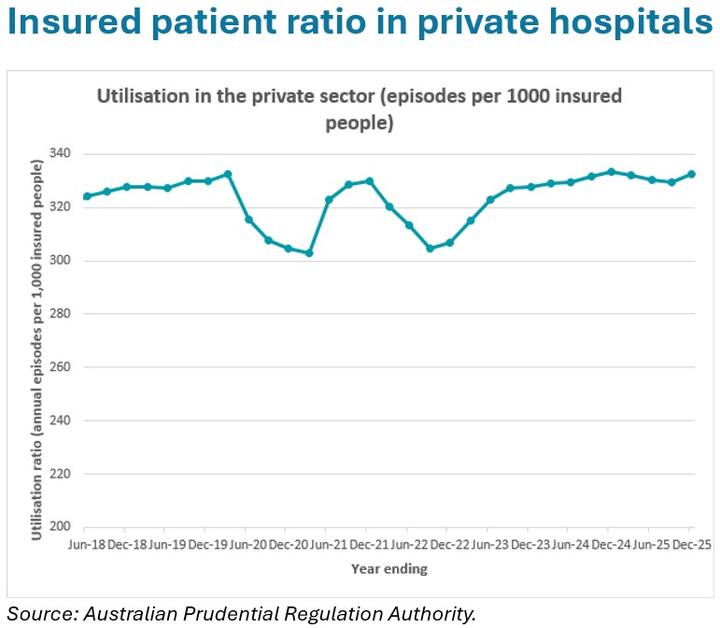
Exacerbating the systemic viability strain heaped upon private hospitals, private hospital utilisation is now above pre-Covid levels, but the benefits ratio paid by insurers is nowhere near the pre-Covid 90% benchmark. As the data from APRA (see graph) shows, in 2019 private hospital utilisation, measured as annual episodes per 1,000 insured people peaked at 330. For the last two years it has hit 333 and 332.
"The facts make a mockery of claims that the benefits ratio paid to private hospitals is lagging due to under-utilisation," APHA CEO Brett Heffernan explained. "In fact, despite more insured patients using private hospitals than ever, insurer payments have failed to keep pace.
"The insurers have made it clear for a year now they have no intention of adhering to Minister Butler's March 2025 ultimatum to dramatically increase the benefits ratio or he would make them.
"With hospitals restricting services and absorbing costs as insurers continue to post record $2 billion a year profits and the highest management expenses ever at $3.4 billion a year, the Federal Government must legislate to force a return to the pre-Covid 90% payout ratio.
"Given the exorbitant profits and fees deducted from the premiums Australians pay each year, the 90% benefits ratio can be achieved without added pressure on premiums. A Mandatory Code of Conduct, in tandem with this payout guarantee, is also needed to bring transparency and fairness to the unconscionable conduct of insurers and make them accountable.
"The unequal bargaining position in contracting between hospitals and insurers has become a murky and fraught arena riddled with abuses that needs to be brought to light.
"Insured patients pay their premiums in good faith expecting their treatment is being met by their health insurance company. In reality, more and more of their premiums are simply lining the pockets of insurers instead of meeting the costs of treatment and care in hospitals."
-ENDS-
Previous Media Centre:
1/3/2026 Strengthening the sustainability of Australia's private hospital system