![[APHA]](/images/logo_apha.svg)
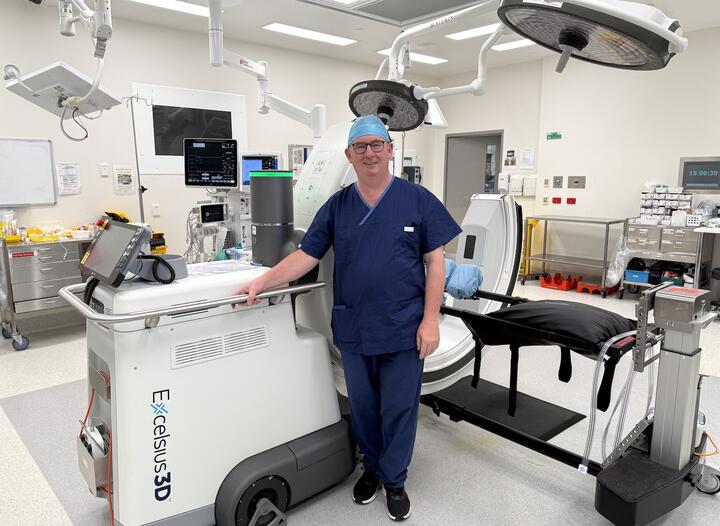
Sydney Adventist Hospital has become only the second healthcare facility in Australia to adopt a state-of-the-art imaging technology that reduces exposure to X-ray radiation.
New South Wales' largest private hospital – also known as the San – was the first in the state to use the G-Arm device, a significant upgrade on its older imaging systems.
It provides high-quality, real-time 3D visualisation during operations, enhancing surgical accuracy and supporting safer, more precise procedures.
The streamlined setup reduces the need for repeated equipment repositioning, helping to shorten procedure times by an average of 30 minutes per case and minimising delays caused by competing imaging demands in theatre.
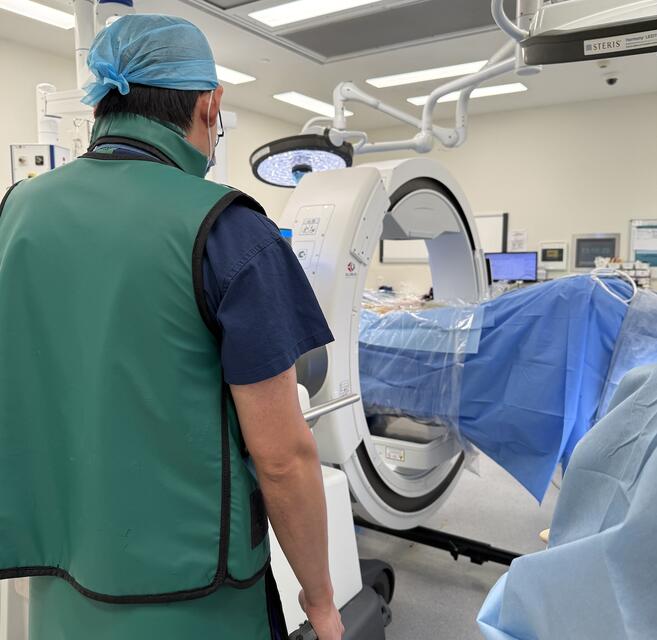
A San radiographer operates the new G-Arm imaging device
The G-Arm technology was used for the first time at the San during a procedure performed by Clinical Professor Brian Owler, the hospital's Head of Neurosurgery.
"The benefits for patients are less X-rays in the operating theatre, especially for larger operations," he said.
"The field of view – how much fits on the X-ray – is much bigger, so instead of doing a couple of scans to capture the whole spine, we can just do one.
"There are also other features that reduce radiation and X-ray dose."
Compared with the previous O-Arm system it has replaced, the G-Arm has a smaller footprint, is easier to position and significantly improves workflow in theatre.
These improvements address long-standing challenges by reducing procedure times and radiation exposure for patients and staff.
"The G-Arm integrates seamlessly with our Globus spine robot," Prof Owler said.
"We use this to place screws or cages with accuracy.
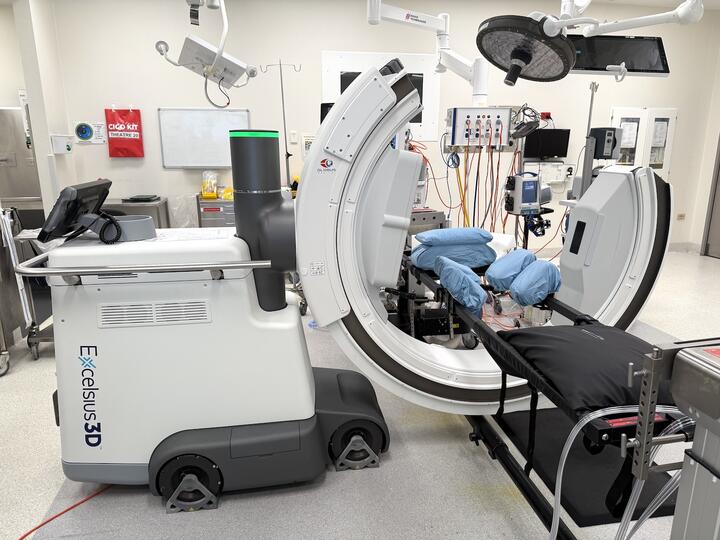
The G-Arm can be used for a variety of surgical specialties
"Our ability to take a scan with the G-Arm on the operating table, plan our operation on the scans, and then accurately place the screws and cages with the robot, makes our spinal surgeries safer and more efficient."
He said the versatile G-Arm system could also be applied to other specialities including complex fracture management in orthopaedics, and tumour localisation and resection guidance in oncology.
Its advanced imaging capabilities enable more complex procedures, while also providing a strong platform for training and education, helping to support the next generation of surgeons.
Read more: How AI can empower older people
Read more: Doctor donates $7m to honour parents
Read more: 'Seed' makes breast cancer surgery simpler
Next News And Innovation:
2/4/2026 San opens Australia's 'most advanced' neurosurgery theatre
Previous News And Innovation:
20/3/2026 New hip alternative offers greater mobility