![[APHA]](/images/logo_apha.svg)
Surgeons at Epworth have proved that two robots are better than one, combining procedures for the first time to offer life-saving treatment in a single surgery.
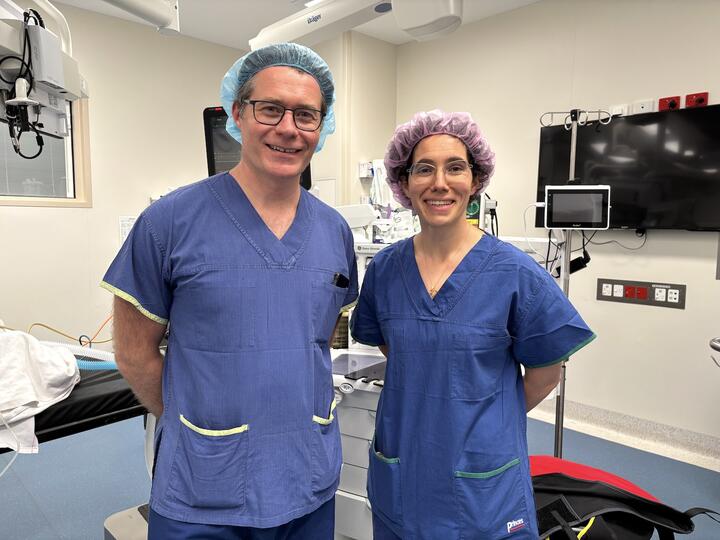
Pulmonologist and respiratory physician Dr Nick Wilsmore teamed up with thoracic surgeon Dr Jazmin Eckhaus to perform the robotic-assisted operation at Epworth Eastern hospital in Melbourne.
The first patient to have this surgery, a 78-year-old woman, had a small lesion in her lung that had started to grow after more than two years of monitoring.
The options were to continue to monitor for further growth, or to have it removed.
"I decided to have it removed," she said. "I thought, 'I'm only 78, with very young grandchildren so I need to stick around a bit longer'.
"I was a bit nervous to be the first person to have this surgery, but I really trusted the doctors, and I felt it was better to have one surgery."
First, Dr Wilsmore located and marked the tiny 6-millimetre lesion with a coil dipped in fluorescent dye using the Ion robotic bronchoscopy platform, which has a built-in navigation system to help specialists precisely access hard-to-reach nodules in the peripheral lung.
Like an athletics relay where runners hand over the baton, Dr Eckhaus then moved into theatre to excise the lesion from the patient's lung using the da Vinci Xi multi-port robotic-assisted surgical system.
This platform enables complex procedures to be performed in a minimally-invasive way with just four tiny incisions.
It was the first time in Australia that both stages of treatment have been completed in one single operation using robotic-assisted diagnostic and surgical technology.
"The fact that it's now possible to do everything in the one procedure, from diagnosis to marking and resection, is astounding," Dr Wilsmore said.
The single procedure avoids the need for a patient to return to hospital within days for a second surgery, and removes the requirement for a second anaesthetic.
"Using the Ion robotic bronchoscope and the da Vinci robotic-assisted surgical systems within the same procedure allows us to coordinate care efficiently while supporting a safe and precise approach for patients," Dr Eckhaus, the only female thoracic surgeon practising in Australia, said.
The patient said the early-stage lung cancer, precisely marked with the glowing coil by Dr Wilsmore, was entirely removed by Dr Eckhaus.
"It was a very early finding, and I don't need chemotherapy or radiation, which is a blessing," she said.
An avid walker, she was back hitting the pavement within two weeks of her surgery.
She is now looking forward to a trip of a lifetime with her husband – a European river cruise – later in 2026.
Epworth is the only hospital operator in Victoria with an Ion robotic bronchoscope, a system 'like Google Maps for your lungs' that helps specialists to navigate through a complex maze of airways with accuracy and stability.
"This new technology means I can rely on the robot to help navigate to the right position inside the lung, and once it's pointed towards the nodule or tumour, it stays perfectly steady as we take a sample or mark it for surgery," Dr Wilsmore said.
The precise nature of the two robotic systems may also allow a smaller segment of the lung to be removed during surgery, preserving more of the healthy tissue.
"The Ion bronchoscope enables us to localise lesions in the lung that we were previously unable to mark for surgery because they were so small," Dr Eckhaus said.
"To remove them, we would sometimes need to take out a larger section of the lung, or the patient might need a second procedure to ensure we have removed it completely."
In late 2025, Epworth launched one of Australia's first Priority Lung Screening Assessment Services.
It supports the Australian Government's National Lung Cancer Screening Program by providing fast access to specialists and advanced diagnostic tools when scans show the need for further investigation.
"Through the national program, asymptomatic people can now undertake scans that will identify any abnormalities," Dr Wilsmore said.
"Patients who might be at risk can now access the Epworth priority service ensuring they receive the right follow-up care quickly."
Read more: Australian-first procedure provides cancer alternative
Read more: New arrivals enhances diagnosis for Victorian patients
Next News And Innovation:
5/5/2026 Australian-first robot arrival benefits Epworth patients
Previous News And Innovation:
14/4/2026 Robot benefits arrive at short-stay hospital