![[APHA]](/images/logo_apha.svg)
At 85 years of age Barry Walker was, in his own words, "fit as a Mallee bull".
However, even the fittest person feels a strain by the time they hit their eighth decade, and for Mr Walker it was arthritis in his shoulders.
The grandfather from Bendigo, Victoria, found he could barely extend his arms above his head. Reaching the top shelf in the pantry was impossible, and even washing his own hair became challenging.
"It was just wear and tear from an active life," he said.
Despite initially trying to avoid surgery, Mr Walker eventually decided to become the first patient at Melbourne's Epworth Richmond hospital to undergo a robotic-assisted shoulder replacement.
"I do quite enjoy being a pioneer," he said.
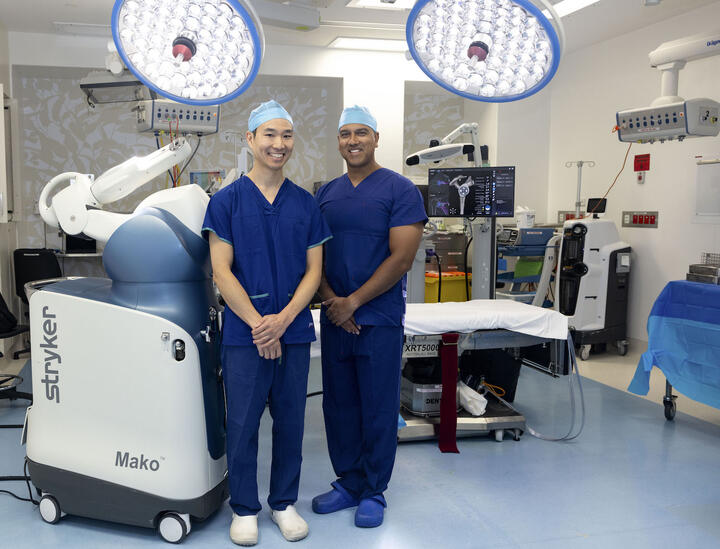
Shoulder, knee and elbow orthopaedic surgeon Dr Soong Chua led the medical milestone alongside orthopaedic upper limb and trauma surgeon Dr Brett Moreira.
"The Mako robotic technology has successfully been used in hip and knee replacement surgery with accuracy and precision, but this was a first for Epworth to use it for shoulder surgery," Dr Moreira said.
Dr Chua, who performed Mr Walker's surgery, said the Mako robotic arm's haptic technology prevents the instrument from deviating outside of set boundaries.
It provides intra-operative, real-time guidance during surgery, ensuring implant placement is extraordinarily accurate.
"The surgery was a reverse total shoulder replacement which is primarily used for patients with severe arthritis of the shoulder," Dr Chua said.
"It is called a reverse because the ball and socket are reversed around. This allows different muscles to move the shoulder and can be an advantage compared to traditional replacements for some patients, particularly those who have rotator cuff problems, which is the majority in the older age group."
The surgery was a success, and Mr Walker is now looking forward to throwing his one-year-old grandson in the air and catching him.
Dr Chua said robotic-assisted surgery could lead to improved short-term, immediate post-operative pain and return of function, as well as function of the shoulder replacement once fully recovered, and long-term implant survivorship.
"Optimal outcomes rely on accurate placement of the components in terms of alignment of the implants and trajectory of the screws that hold the implant in place," he said.
"Accurate placement should mean better function for the patient in terms of final movement and use once fully recovered."
Epworth's 'exciting new chapter'
The Mako 4 is the latest tool in Epworth Richmond's robotic-assisted orthopaedic surgery program – it is now the first hospital in Australia and New Zealand to have four Mako systems.
It is also one of few facilities in the region to offer robotic-assisted shoulder replacements in addition to those for knees and hips, which have been performed at the Victorian private healthcare group with Mako machines since 2017.
Mr Andrew Tang, Epworth's Head of Robotic Orthopaedic Surgery, said this marked an exciting chapter in the hospital's history of embracing new technology.
"Epworth is at the forefront of orthopaedic robotics in Australia," Mr Tang said.
"The Epworth robotic program has grown to offer orthopaedic surgeons the use of multiple systems, including the Mako, and our experience delivering robotic-assisted surgery is extensive.
"Since 2017, we have performed more than 10,000 robotic-assisted joint replacement surgeries.
"I'm proud of every surgeon who has contributed to this success so far, and we have a fantastic group of young surgeons coming through who will elevate the Epworth robotic program even further."
Read more: Australian-first 'robot relay' a blessing for elderly patient
Read more: State-first surgery at San increases shoulder options
Next On The Ground:
11/6/2026 Puppy power of healing extends impact at Brisbane hospital
Previous On The Ground:
8/5/2026 Hospital donation helps surgeon improve refugees' lives