![[APHA]](/images/logo_apha.svg)
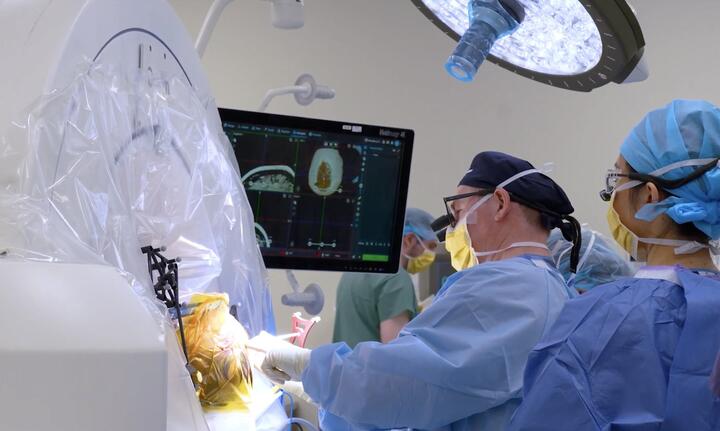
Sydney Adventist Hospital is leading the way in the treatment of Parkinson's disease, performing the first robotic-assisted Deep Brain Stimulation (DBS) procedure in the Asia-Pacific region.
Led by Head of Neurosurgery, Clinical Professor Brian Owler, the team used a new cranial arm attachment to the Globus ExcelsiusGPS robotic ecosystem recently acquired by New South Wales' largest private hospital, also known as the San.
"The technology is a game-changer – not just for Parkinson's patients, but for a broad range of neurological procedures," Prof Owler said.
"While this milestone was achieved in a DBS procedure, the technology can be used across a wide range of cranial stereotactic procedures, from routine biopsies to highly complex interventions."
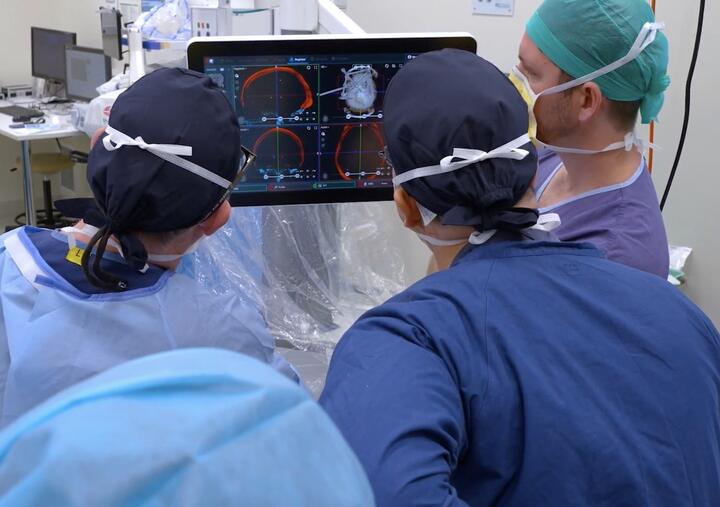
The robot system uses advanced imaging to enhance accuracy
DBS is one of the most effective treatments for managing symptoms of Parkinson's disease, a progressive brain disorder that affects more than 150,000 Australians.
The procedure involves implanting tiny electrodes into targeted areas of the brain to regulate abnormal signals responsible for symptoms such as tremors, stiffness and impaired movement.
Traditionally, DBS surgery requires patients to remain awake while electrodes are implanted, allowing surgeons to confirm precise placement in real time.
Prof Owler said the introduction of robotic-assisted technology was now transforming this approach.
He said the cranial robotic arm enabled highly precise and consistent electrode placement, meaning most procedures could now be performed under general anaesthetic, significantly improving patient comfort and expanding access to more patients.
"The system uses advanced imaging and navigation to enhance accuracy, while minimising radiation exposure and simplifying what are traditionally complex procedures," Prof Owler said.
"The increased precision also significantly reduces surgery time by approximately 48 percent, delivering flow-on benefits for patient safety, operating efficiency and recovery."
Read more: San opens Australia's 'most advanced' neurosurgery theatre
Read more: San's robot firsts open up regional care options
Next Safety And Quality:
30/6/2026 Trial success 'a lifeline' for Hodgkin lymphoma patients
Previous Safety And Quality:
5/5/2026 State-first surgery at San increases shoulder options