![[APHA]](/images/logo_apha.svg)
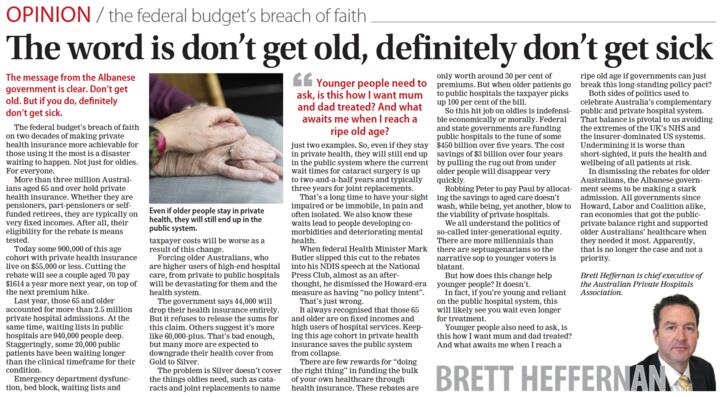
APHA's Opinion Editorial in the Canberra City News.
THE message from the Albanese Government is clear. Don't get old. But if you do definitely don't get sick.
The Federal Budget's breach of faith on two decades of making private health insurance more achievable for those using it the most is a disaster waiting to happen. Not just for oldies. For everyone.
Over 3 million Australians aged 65 and over hold private health insurance. Whether they are pensioners, part-pensioners or self-funded retirees, they are typically on very fixed incomes. Afterall, their eligibility for the rebate is means tested.
Today some 900,000 of this age cohort with private health insurance live on $55,000 or less. Cutting the rebate will see a couple aged 70 pay $1,614 more next year.
Last year, those 65 and older accounted for over 2.5 million private hospital admissions. At the same time, waiting lists in public hospitals are 940,000 people deep. Staggeringly, some 20,000 public patients have been waiting longer than the clinical timeframe for their condition.
Emergency Department dysfunction, bed block, waiting lists and taxpayer costs will be worse as a result of this change. Forcing older Australians, who are higher users of high-end hospital care, from private to public hospitals will be devastating for them and the health system.
The government says 44,000 will drop their health insurance entirely. But it refuses to release the sums for this claim. Others suggest it's more like 60,000-plus. That's bad enough, but many more are expected to downgrade their health cover from Gold to Silver.
The problem is Silver doesn't cover the things oldies need, like cataracts and joint replacements to name just two examples. So, even if they stay in private health, they will still end up in the public system where the current wait times for cataract surgery is up to two-and-a-half years and typically three years for joint replacements.
That's a long time to have your sight impaired or be immobile, in pain and often isolated. We also know these waits lead to people developing co-morbidities and deteriorating mental health.
When Federal Health Minister Mark Butler slipped this cut to the rebates into his NDIS speech at the National Press Club, almost as an after-thought, he dismissed the Howard-era measure as having 'no policy intent'.
That's just wrong.
It always recognised that those 65 and older are on fixed incomes and high users of hospital services. Keeping this age cohort in private health insurance saves the public system from collapse.
There are few rewards for 'doing the right thing' in funding the bulk of your own healthcare through health insurance. These rebates are only worth around 30% of premiums. But when older patients go to public hospitals the taxpayer picks up 100% of the bill.
So this hit job on oldies is indefensible economically or morally. Federal and state governments are funding public hospitals to the tune of some $450 billion over five years. The cost savings of $3 billion over four years by pulling the rug out from under older people will disappear very quickly.
Robbing Peter to pay Paul by allocating the saving to aged care doesn't wash, while being, yet another, blow to the viability of private hospitals.
We all understand the politics of so-called inter-generational equity. There are more millennials than there are septuagenarians so the narrative sop to younger voters is blatant.
But how does this change help younger people? It doesn't.
In fact, if you're young and reliant on the public hospital system, this will likely see you wait even longer for treatment.
Younger people also need to ask, is this how I want mum and dad treated? And what awaits me when I reach a ripe old age if governments can just break this long-standing policy pact?
Both sides of politics used to celebrate Australia's complementary public and private hospital system. That balance is pivotal to us avoiding the extremes of the UK's NHS and the insurer-dominated US systems. Undermining it is worse than short-sighted, it puts the health and wellbeing of all patients at risk.
In dismissing the rebates for older Australians, the Albanese Government seems to be making a stark admission. All governments since Howard, Labor and Coalition alike, ran economies that got the public-private balance right and supported older Australians' healthcare when they need it most.
Apparently, that is no longer the case and not a priority.
Brett Heffernan is chief executive of the Australian Private Hospitals Association. Published in the Canberra City News on 2 July 2026.
Next Feature Articles:
16/7/2026 The secret insurer rort forcing private hospitals to close
Previous Feature Articles:
27/5/2026 Hit job on oldies not healthy