![[APHA]](/images/logo_apha.svg)
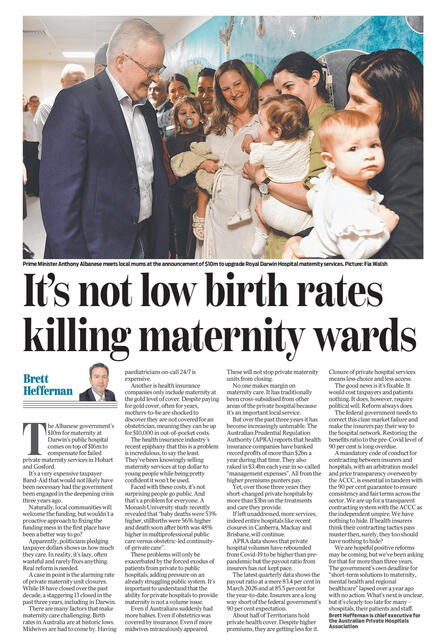
APHA's Opinion Editorial in the Sunday Territorian.
THE Albanese Government's $10 million for maternity at Darwin's public hospital comes on top of $16 million to compensate for failed private maternity services in Hobart and Gosford.
It's a very expensive taxpayer band-aid that would not likely have been necessary had the government been engaged in the deepening crisis three years ago.
Naturally, local communities will welcome the funding, but wouldn't a proactive approach to fixing the funding mess in the first place have been a better way to go?
Apparently, politicians pledging taxpayer dollars shows us how much they care. In reality, it's lazy, often wasteful and rarely fixes anything. Real reform is needed.
A case in point is the alarming rate of private maternity unit closures. While 18 have closed over the last decade, a staggering 13 closed in just the last three years, including in Darwin.
There are many factors that make maternity care challenging. Birth rates in Australia are at historic lows. Midwives are had to come by. Having paediatricians on-call 24/7 is expensive.
Another is health insurance companies only include maternity at the Gold level of cover. Despite paying for Gold cover, often for years, mothers-to-be are shocked to discover they are not covered for an obstetrician, meaning they can be up for $10,000 in out-of-pocket costs.
The health insurance industry's recent epiphany that this is a problem is incredulous to say the least. They've been knowingly selling maternity services at top dollar to young people while being pretty confident it won't be used.
Faced with these costs, it's not surprising people go public. And that's a problem for everyone. A Monash University study recently revealed that "baby deaths were 53% higher, stillbirths were 56% higher and death soon after birth was 48% higher in multi-professional public care versus obstetric-led continuity-of-private care".
These problems will only be exacerbated by the forced exodus of patients from private to public hospitals, adding pressure on an already struggling public system.
It's important to understand that the ability for private hospitals to provide maternity is not a volume issue.
Even if Australians suddenly had more babies. Even if obstetrics was covered by insurance. Even if more midwives miraculously appeared. These will not stop private maternity units from closing.
Noone makes margin on maternity care. It has traditionally been cross-subsidised from other areas of the private hospital because it's an important local service.
But over the last three years it has become increasingly untenable. The Australian Prudential Regulation Authority (APRA) reports that health insurance companies have banked record profits of over $2 billion a year during that time. They also raked in $3.4 billion each year in so-called 'management expenses'. All from the higher premiums punters pay.
Yet, over those three years they short-changed private hospitals by more than $3 billion on the treatments and care they provide. It can come as no surprise to anyone that this is unsustainable.
If left unaddressed, more services, indeed entire hospitals like recent closures in Canberra, Mackay and Brisbane, will continue.
APRA data shows that private hospital volumes have rebounded from COVID-19 to be higher than pre-pandemic but the payout ratio from insurers has not kept pace.
The latest quarterly data shows the payout ratio at a mere 83.4% in March 2026 and at 85.5% for the year-to-date. Insurers are a long way short of the federal government's 90% expectation.
Around half of Territorians hold private health cover. Despite higher premiums they are getting less for it. The closure of private hospital services means less choice and less access.
The good news is it's fixable. It would cost taxpayers and patients nothing. It does, however, require political will. Reform always does.
The federal government needs to correct this clear market failure and make the insurers pay their way to the hospital network. Restoring the benefits ratio to the pre-Covid level of 90% is long overdue.
A Mandatory Code of Conduct for contracting between insurers and hospitals, with an arbitration model and price transparency overseen by the ACCC, is essential in tandem with the 90% guarantee to ensure consistency and fair terms across the sector.
We are up for a transparent contracting system with the ACCC as the independent umpire. We have nothing to hide. If health insurers think their contracting tactics pass muster then, surely, they too should have nothing to hide?
We are hopeful positive reforms may be coming, but we've been asking for that for more than three years. The government's own deadline for "short-term solutions to maternity, mental health and regional healthcare" lapsed over a year ago with no action. What's next is unclear, but it's clearly too late for many private hospitals, their patients and staff.
Brett Heffernan is chief executive for the Australian Private Hospitals Association. Published in the Sunday Territorian on 26 July 2026.
Next Feature Articles:
30/7/2026 What corners are being cut in your healthcare?
Previous Feature Articles:
16/7/2026 The secret insurer rort forcing private hospitals to close