![[APHA]](/images/logo_apha.svg)
NEW research highlights the major economic footprint of Australia's private hospitals, contributing (directly and indirectly) over $27 billion to the economy last year, while underpinning the jobs of more than 229,000 Australians. The data comes as an ironic twist given the sector itself is struggling, recording a $756 million operating loss over the same period.
While many know the leading healthcare role private hospitals play, like 70% of planned surgery, 60% of acute mental healthcare, 82% of rehabilitation and most of many medical treatments people rely on every day, including 53% of chemotherapy, the economic value has been unclear.
Economic analysis by ACIL Allen for the APHA shows that private hospitals generate over $27 billion-a-year in economic activity to account for around 1% of GDP, while supporting more than 229,000 Aussie jobs, or 1.57% of all jobs in the economy.
"The economic footprint of private hospitals shows the sector is a major supplier of local jobs, a key economic driver and a vital component in making related industries tick, while affording millions of patients each year the high-quality, timely care they need," APHA CEO Brett Heffernan said.
"The national and state-by-state data illustrates the substantial role private hospitals play as drivers of local economic activity, along with their value to related sectors upstream and downstream in the healthcare supply chain."
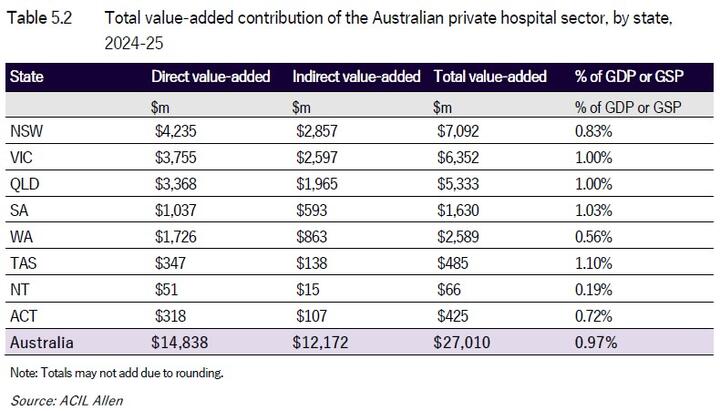
(Table 5.2 from the report [right] shows the national and state-by-state economic breakdown).
Private hospitals spent $8.3 billion on intermediate goods and services in 2024-25. In terms of domestically supplied inputs, this comprised $1.3 billion on administrative support (16% of all intermediate goods and services), $1.1 billion on financial and insurance services (13%) and $947 million on professional, scientific and technical services (11%).
"This contribution underscores the vital case for private hospital viability," Mr Heffernan said. "While health insurance companies racked up operating profits of $2.7 billion last year, private hospitals are being short-changed by insurers and going backwards losing $756 million over the same period.
"The resultant closure of entire private hospitals and shutting down of services in others, notably maternity and mental health, is a downward cycle that is detrimental to healthcare delivery, economic activity and the jobs Australian families rely on."
The employment data from the ACIL Allen report also shows the important place private hospitals occupy in healthcare and the national and state economies. Directly employing 158,600 people, the sector underpins another 71,222 jobs in upstream and downstream sectors. In all, 229,822 Australians rely on private hospitals for their livelihoods.
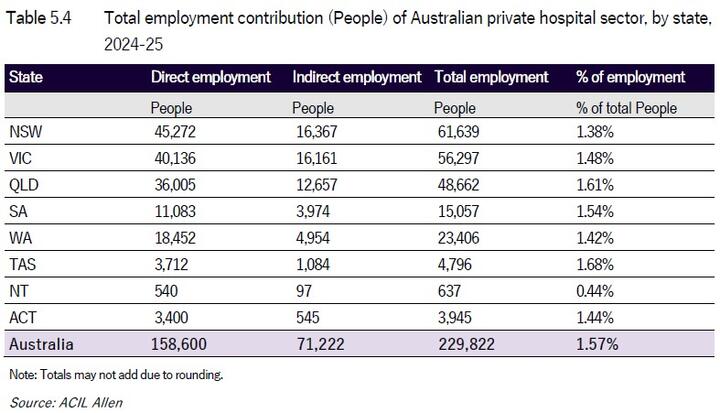
(Table 5.4 from the report [right] shows the national and state-by-state breakdown of jobs in the economy).
"In addition to the clinicians, nurses, wards people, catering and administration staff in private hospitals, a swathe of allied jobs rely on the sector," Mr Heffernan explained. "On top of the 158,600 jobs in hospitals, another 71,222 are created elsewhere.
"These include 11,356 people in administrative and support services (16% of total indirect jobs), 9,464 in professional, scientific and technical services (13%), 8,158 people in health care and social assistance (11%), and 6,720 people in finance and insurance services (9%).
"Last year, private hospitals admitted over 5.1 million patient cases. The sector's fundamental importance to the lives of those directly relying on it traverses all walks of life across metropolitan, suburban, peri urban, regional and rural Australia.
"It also indirectly positively impacts the lives of all Australians, shouldering a healthcare burden and economic footprint that would otherwise see many industries and the jobs they support disappear, in addition to the collapse of the public health system."
The full ACIL Allen report, Economic Contribution of Australian Private Hospitals, is available on the APHA website at: Economic Contribution of Australian Private Hospitals.
-ENDS-
Previous Media Centre:
24/8/2026 Changes to PHI for 65+ age cohort a 'disaster-in-waiting'