![[APHA]](/images/logo_apha.svg)
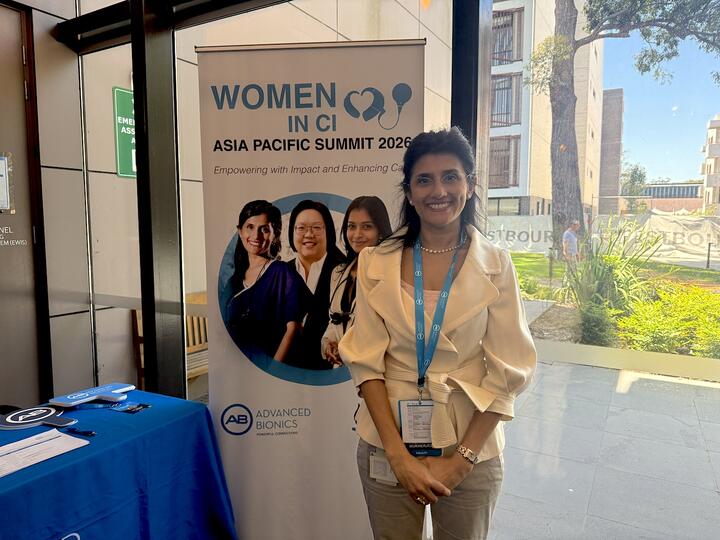
Advances in hearing aid technology, Artificial Intelligence (AI), and guidelines for getting adults referred for cochlear implants were among the issues discussed at a recent conference hosted by Sydney Adventist Hospital.
The 'Women in CI Asia Pacific Summit' brought together female surgeons and audiologists from several countries in the region.
Professor Payal Mukherjee, an ear, nose and throat (ENT) surgeon at New South Wales' largest private hospital – also known as the San – said Australia's newly-released national guidelines for adult cochlear implants was a key focus of the event.
"Hearing loss is part of aging, and as they age, a lot of people are given hearing aids, but it may not be the right solution for them.
"The issue has been agreeing on when it is appropriate to refer someone for a cochlear implant. There hasn't been a national framework for those guidelines," said Prof Mukherjee, who is co-chair of the Australian and New Zealand Hearing Health Collaborative.
"So we are seeing older people getting hearing aids but their life hasn't changed, and we know that hearing loss as we age is linked to increasing rates of dementia.
"Now we have these consensus guidelines, and we are looking to collaborate with GPs to raise awareness about this."
AI is also playing a greater role in helping patients with hearing loss.
Prof Mukherjee said Bluetooth technology could already link hearing aids with phones and televisions, and with the addition of AI it could improve patient experience.
"The AI is there to predict where the patient is – what is the environment, or the background noise – and it chooses the mode of hearing aid the patient needs," she said.
"It's there to make life easier and it chooses the mode of hearing you need, without you having to pick and choose.
"It's the equivalent of having a smart television, as opposed to a black and white TV – that's the leap in technology we're seeing. It empowers patients."
Prof Mukherjee said AI was also helping patients who had both hearing aids and a cochlear implant – a small electronic device that bypasses the damaged part of the ear and converts sound into signals which stimulate the auditory nerve.
"Previously, the microphone of one would work one way, and the microphone of the other device would work in a different way," she said.
"With AI, those devices can work together, using one app, and the entire hearing journey of a patient can now be a lot smoother."
There are also hopes that AI software can be used to help roll out the new cochlear implant guidelines for adult patients.
"We would hope that eventually every audiologist would have software that could print out information for the patient that says, 'this patient is best served with a hearing aid', or 'this patient needs a referral for a cochlear implant'," Prof Mukherjee said.
"That way, for the audiologist, they don't have to be doing all the nitty gritty – the AI does it for them.
"Social connection as we age is so important. Older people still have so much to contribute and if they can't hear, we're silencing them."
Prof Mukherjee said she left the summit feeling uplifted.
"What really touched me about the summit was that it was the first summit for women in this field and to hear how these women were making a difference in their communities was inspirational," she said.
"It's really a case of being the change you want to see in the world and in the lead-up to International Women's Day (Sunday 8 March 2026), these stories need to be amplified.
"At a time when the world is fighting each other, it's inspirational to see these stories and know that people are out there making a difference and achieving outcomes for their communities."
Read more: Young people working for global health solutions
Read more: Australian-first AI system keeps patients safe
Next News And Innovation:
28/2/2026 $16 million expansion to meet rising demand in Sydney's south
Previous News And Innovation:
24/2/2026 International recognition for Icon specialists