![[APHA]](/images/logo_apha.svg)
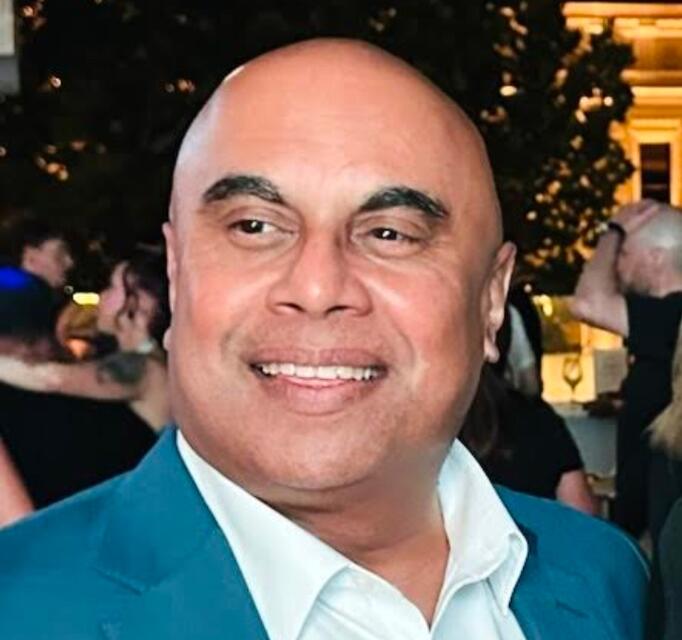
Service to his community has been at the heart of Dr Rondhir Jithoo's career for more than 20 years.
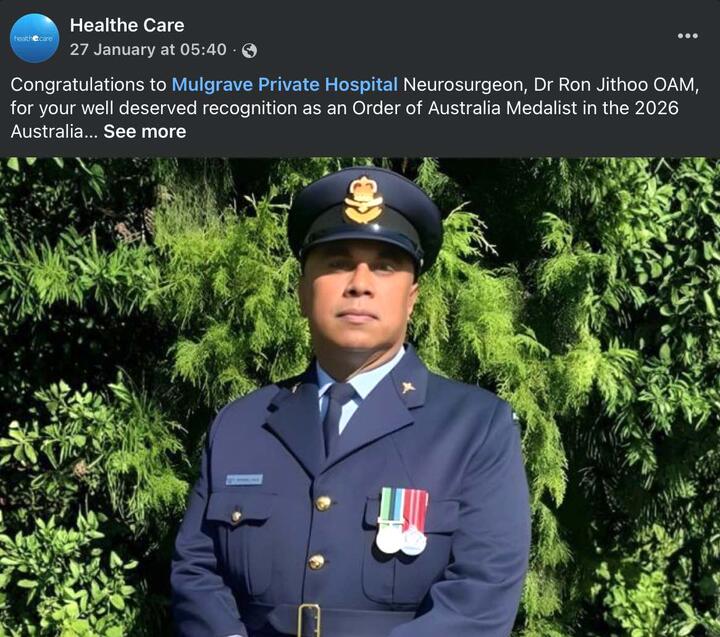
That service has been recognised, with the Melbourne-based neurosurgeon awarded a Medal of the Order of Australia (OAM) in the 2026 Australia Day Honours List.
Dr Jithoo, the Chief Medical Officer at Mulgrave Private Hospital, said he was incredibly thankful for the honour.
"I feel a sense of gratitude to the community – this is not an academic award, it's from the community for community service, so it's nice to receive it," he said.
Dr Jithoo has played a prominent role in public and private healthcare, medical education, defence medicine and international surgical outreach.
He has served as a consultant neurosurgeon at Alfred Health since 2010 and previously held leadership roles including Acting Head of Neurosurgery and Surgical Training Supervisor.
Along with his work at Healthe Care's Mulgrave Private Hospital in southeast Melbourne, he practises across several Victorian and interstate hospitals, including Royal Darwin Hospital.
Military lessons
Dr Jithoo also has a distinguished career with the Australian Defence Force. He served as a reserve combat neurosurgeon in the Middle East during operation OKRA and holds the rank of Wing Commander in the Royal Australian Air Force Specialist Reserve.
He said serving in combat zones had given him a fresh perspective on practising medicine.
"When you are in a deployed environment, it's an uncontrolled environment, there is an element of personal danger, you're working in a structure that is often not fixed, like a tent," Dr Jithoo said.
"A deployment hospital is made to be packed up and moved. And it's often near an airfield. It's actually a lot like (television show) 'M*A*S*H', the principles are the same.
"When I work at the Alfred, it's a nice brick building, we have security guards. The Emergency Department can be a chaotic environment, with some odd characters running around but it's fairly reasonable compared to being on deployment."
Dr Jithoo said working in a conflict zone had its practical limitations, and medical staff were often called on to go the extra mile.
"You might only have 10 units of blood on hand, so you have what is called a walking blood bank, and often people who are there serving are called on to give a unit of blood," he said.
"I never planned to join the ADF. I had been involved in training trauma surgeons for them, and they asked me to join.
"I refused initially, I was not keen, but they were gently persistent and eventually I gave in! I don't regret it of course, but it was never my ambition from high school to join the military."
Private sector 'is really efficient'
Working extensively across both the public and private sectors, Dr Jithoo said he would like to see greater co-operation between Australia's health services.
"I do think the public and private systems exist symbiotically," he said.
"They're two sides of the same coin. They're both equally important. I do think the private system could be better utilised, it's so efficient when it comes to cardiac surgery, orthopaedics, cancer screening, so many things.
"For certain things, like big trauma events, the public sector is hard to beat. But for other things, the private sector is really efficient and is doing the heavy lifting when it comes to elective surgery."
After such a distinguished career in a wide range of locations, Dr Jithoo said his experience helping one patient was a memorable highlight.
"It was a young lady, a university academic, who had been run over, and I performed surgery on her – she was in a bad way," he said.
"She has managed to make a full recovery, go back to work – and become a patient advocate for us as well.
"She's also having her second child, so to see someone go from almost the brink of death to be able to recover and give birth to another human being, it's a beautiful full circle moment.
"Her husband and her first child were very grateful and happy, and that is something that I find very gratifying."
The importance of a support network
Having been awarded an OAM, Dr Jithoo said it was important to remember he had not achieved the honour on his own.
"I have two adult children who keep me in check," he said.
"My daughter Ayra is a neurophysiologist, and my son Ved, he's just finished his medical internship at John Hunter Hospital in New South Wales.
"They're very good, teasing me – mostly about my sense of fashion. They keep me grounded; I'm very much just a daggy dad to them."
Professionally, he thanked Professor Jeffrey Rosenfeld for being "a wonderful mentor".
"He was the first Australian neurosurgeon to serve in Iraq, and he has worked in Papua New Guinea. We have many teachers in life, but for me having Jeffrey there has been wonderful," Dr Jithoo said.
He said the support of nursing and other staff was essential to the success of any clinician – and in turn, outcomes for patients.
"Medical staff and hospitals are often only in the news when it's bad news – people get the idea that the health system is populated by rogue practitioners but, by and large, that's just not true," he said.
"In the private sector, you're more closely associated with the patient. And when you see people for surgery, they're obviously not at their best – they're frightened or worried.
"And what I'm always struck by is how good the staff are, how cheerful they are. I see the staff putting patients at ease, and their goodwill and professionalism is amazing.
"Everyone can be fun when you're at the pub on Friday night, but to keep that up when it's a stressful time or a stressful environment, that's something special.
"They understand we all have to give 110 percent for the patient, and I see people rise to the occasion all the time."
Read more: King's Birthday Honours 2025: Private healthcare stalwarts recognised
Read more: Indigenous surgeon's AM honour 'a sign to do more'
Next On The Ground:
19/3/2026 Surgeon puts Paralympian 'back together a second time'
Previous On The Ground:
23/2/2026 Wollongong Private Hospital celebrates 10th anniversary